




When a commercial roof leaks, it's more than a drip in a bucket. It's wet inventory, damaged ceiling tiles, and customers or tenants who notice. Dubya Roofing and Gutters repairs and maintains flat and low-slope roofs on shops, offices, churches, warehouses, and other commercial buildings from our home base in Rowesville, SC. TPO roof repair is a big part of what we do, since so many commercial buildings around Orangeburg County sit under a white TPO membrane. Whether you need a leak found and fixed today or want someone keeping an eye on your roof year-round, we'll look it over, tell you straight what we see, and give you a free estimate.
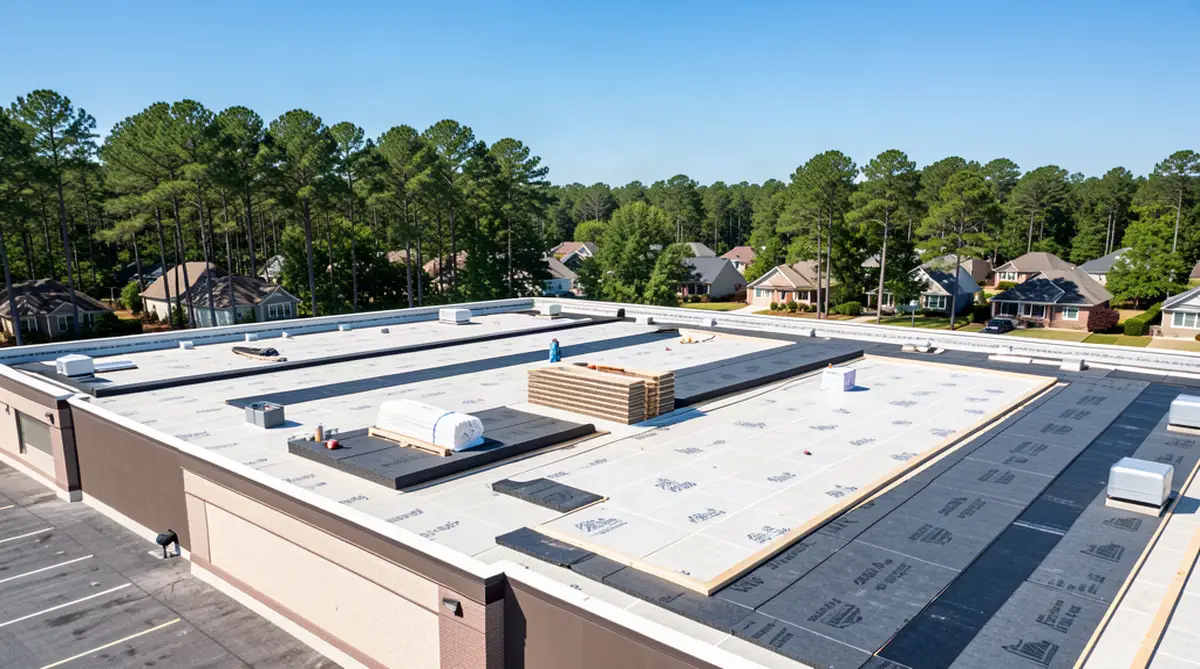
TPO Roof Repair
TPO (thermoplastic polyolefin) is a single-ply membrane, usually white, that's one of the most common roofs on commercial and low-slope buildings. The sheets are joined by heat-welding the seams together, so a good TPO roof acts like one continuous skin. That white surface reflects a lot of the South Carolina sun, which is a big reason building owners choose it. But TPO isn't maintenance-free. Seams, flashings, and the membrane itself can take damage from heat, storms, foot traffic, and time. If you want to learn more about TPO and other flat roof systems, see our flat roofing page.
Signs You Need TPO Repair
Most TPO problems start small. A seam lifts a little, a tool gets dropped near an HVAC unit, or water starts sitting in one low spot after every rain. From the ground you'll probably never see it. Inside, it may show up as a stain on a ceiling tile, a musty smell, or a drip that only happens in hard, wind-driven rain. Catching these early almost always means a simpler, less expensive repair than waiting until water has soaked the insulation underneath. Here's what to watch for:
- Seams that are lifting, curling, or feel loose along the edges.
- Punctures, cuts, or tears in the membrane, especially near equipment and walkways.
- Water standing on the roof two days or more after a rain.
- Flashing pulling away from walls, curbs, pipes, or roof edges.
- Water stains, sagging ceiling tiles, or drips inside the building.
- Membrane that looks shrunk, wrinkled, cracked, or worn down to the scrim.
Seam Failures
Heat-welded seams are what hold a TPO roof together, and they're also where many leaks start. Over time, heat cycles, building movement, and poor original welds can let a seam open up. When we find a weak seam, we clean the area, test it, and repair it with compatible TPO material, heat-welding new membrane over the problem spot so the repair bonds the same way the original roof did. Patching TPO with the wrong caulk or a mismatched product usually fails fast, so we stick with materials made to work with your existing membrane.
Punctures and Tears
TPO is tough, but it isn't bulletproof. Dropped tools, HVAC service visits, fallen limbs, hail, and blown debris can all puncture or tear the membrane. A small, clean puncture can often be fixed with a heat-welded TPO patch. Larger tears, or damage that's let water into the insulation, may need a section of membrane and wet insulation cut out and replaced. We'll check the area around the damage, not just the hole itself, so you know whether a patch will do the job or whether the problem is bigger than it looks.
Ponding Water
Low-slope doesn't mean no slope. Water is supposed to move off the roof to drains, scuppers, or gutters. When it sits in the same spot after every rain, it puts extra weight and wear on the membrane and finds any weak seam nearby. Ponding is often caused by clogged drains, sagging decking, or insulation that's been crushed or soaked. Fixing the leak alone won't stop it from coming back, so if drainage is the root cause, we'll include clearing or correcting it as part of the repair plan.
Flashing and Penetration Leaks
Most commercial roof leaks don't come from the middle of the roof. They come from where the roof meets something else: parapet walls, roof edges, HVAC curbs, vent pipes, skylights, and conduit. These spots get flashed with TPO and sealed, and they're the first places to move, crack, or pull loose. We inspect and repair flashing at every penetration and edge, re-weld or replace failed pieces, and make sure the detail sheds water the way it should.
TPO Repair vs. Replacement
Not every leaking TPO roof needs replacing. If the membrane is in fair shape and the damage is limited to a few seams, punctures, or flashings, a solid repair can keep the roof working for years. Replacement makes more sense when the membrane is brittle or worn through in large areas, when leaks keep popping up in new places, or when a lot of the insulation underneath is wet. We'll walk the roof, show you what we found, and give you an honest recommendation either way. If replacement is the better call, our flat roofing page explains the systems we install.
Commercial Roof Maintenance
A commercial roof is one of the biggest investments in your building, and it's usually the one nobody looks at until it leaks. Regular maintenance changes that. A few planned visits a year let small problems get fixed while they're still small, before water reaches insulation, decking, or what's inside. For commercial buildings, that means fewer emergency calls, fewer surprise repair bills, and a clear record of the roof's condition. Our roof inspection and roof maintenance pages cover our general and residential services. This section is about commercial and low-slope buildings.
Inspections
A commercial roof inspection is a walk of the whole roof, not a glance from the ladder. We check the membrane surface, every seam, roof drains and scuppers, gutters, flashing at walls and edges, and every penetration and equipment curb. We look for ponding, debris, and damage from service traffic. You'll get photos and notes on what we found, so you have a record for your files, your insurance, or your property manager. For most commercial roofs we recommend an inspection in the spring and fall, plus a check after any major storm or hail.
Maintenance Plans
If you'd rather not keep track of it yourself, we can set up a recurring maintenance plan for your building. We'll agree on how often we come out, what we check and clean each visit, and how we handle any repairs we find, so nothing gets done without your OK. After each visit you'll get a short report with photos. Plans are built around your roof, your building, and your budget. To ask about one, call (803) 855-1850 or request a free estimate and tell us a little about your property.
Preventive Work
Most preventive work is simple, and that's the point. We clear leaves and debris from the roof, drains, and scuppers so water can get off the roof. We reseal and touch up flashing and penetrations where sealant has dried out. We patch small punctures and open seams before they leak. We check edge metal, fasteners, and curbs for anything loose. And we write down anything that needs watching, so you can plan and budget for bigger repairs instead of being surprised by them.
Commercial Roof Repair
We repair more than TPO. Many commercial buildings around here have EPDM rubber, modified bitumen, built-up, or metal roofs, and each fails in its own way. Whatever's on your building, we'll track down where the water is getting in, fix it with materials that match your roof, and check the area around it so the leak doesn't just move a few feet over. For general repairs, see our roof repair page. If water is coming in right now, our emergency roof repair page explains what to do, and our storm damage restoration page covers wind and hail damage.
Common Commercial Roof Repairs
Commercial roofs take a beating that home roofs usually don't. They're big and flat, they carry heavy HVAC equipment, and service techs walk across them all year. Water moves slowly on a low-slope roof, so any weak spot gets tested every time it rains. Add South Carolina heat, summer thunderstorms, and the occasional tropical storm, and the same handful of problems show up over and over. These are the repairs we're called for most often on commercial buildings:
- Finding and stopping leaks around HVAC units, curbs, and rooftop equipment.
- Repairing failed flashing at parapet walls, roof edges, and penetrations.
- Patching punctures, splits, and blisters in TPO, EPDM, and modified bitumen roofs.
- Clearing and repairing clogged drains, scuppers, and gutters that cause ponding.
- Fixing wind and hail damage, including loose edge metal and torn membrane.
Our Commercial Repair Process
A good repair starts with finding the real source of the leak, which isn't always right above the drip. Here's how we handle a commercial roof repair from the first call to the finished job, so you know what to expect and nothing gets done without your say-so.
- Call or request an estimate. Call (803) 855-1850 or request a free estimate online. Tell us about the building, the roof type if you know it, and where you're seeing leaks or damage. We'll set up a time to come take a look.
- Roof walk and leak tracing. We walk the whole roof and check the inside of the building where water is showing. Because water can travel under a membrane before it drips, we trace it back to where it's really getting in.
- Photos and a clear estimate. You'll get photos of what we found and a written estimate that explains the repair in plain words. If we see other problems worth fixing soon, we'll point those out separately so you can decide.
- Repair with matching materials. Once you approve the work, we schedule it and make the repair with materials made for your roof system. We work around your business hours as best we can to keep things running inside.
- Final check and cleanup. When the repair is done, we check our work, clean up the roof and the ground, and send you photos of the finished repair. That's also a good time to talk about a maintenance plan.
Repair vs. Replacement
Repairing a commercial roof is almost always less disruptive than replacing it, and often the right call. If the problems are limited to certain areas and the rest of the roof is sound, targeted repairs can buy you real time. But if leaks keep showing up in new places, the membrane is worn out across the roof, or a lot of the insulation underneath is wet, you can end up paying for repair after repair. In that case, replacement may cost less in the long run. We'll tell you honestly which one we'd do if it were our building. See our flat roofing page for replacement systems.
Commercial Roofing Service Area
Dubya Roofing and Gutters is based in Rowesville, SC, and we handle commercial roof repair and maintenance throughout Orangeburg County and across South Carolina. Whether your building is a small shop on Main Street or a warehouse off the interstate, we'll come out, look at the roof, and give you a free estimate. Our office hours are 8 AM to 5 PM, Monday through Friday. Call us at (803) 855-1850, or visit our South Carolina roofing company page to see more about the areas we serve.
Why Choose Dubya Roofing and Gutters
We're a locally owned roofing company in Rowesville, SC, and we've been serving our neighbors since 2020. Business owners and property managers call us because we show up when we say we will, tell the truth about what we find, and don't push a new roof when a repair will do. We know commercial and low-slope roofs, from TPO and EPDM to modified bitumen and metal, and we know how the South Carolina heat and storms wear on them. Every estimate is free, and every job comes with photos so you can see exactly what was done, even if you never set foot on the roof.
- Licensed & Insured — Our crews carry insurance on every job, so your building and your business are protected while we work on your roof.
- Honest repair-or-replace advice — We'll tell you when a repair will do the job and when it won't, and we'll never push a replacement you don't need.
- Photos on every job — You'll see what we found and what we fixed, with photos for your records, your insurance, or your property manager.
- Work around your business — We plan repairs and maintenance visits around your hours as best we can, so you can keep the doors open.
- Free estimates — Every inspection estimate is free, with a clear written price before any work starts and no pressure.
Frequently Asked Questions
What is a TPO roof?
What are the signs a TPO or commercial roof needs repair?
What does commercial roof maintenance include?
How often should a commercial roof be inspected?
Can a commercial roof be repaired, or does it need to be replaced?
Do you offer commercial roof maintenance plans?
Do you repair commercial and TPO roofs in Orangeburg County?
Get a Free Estimate
Leak or worn roof on your building? Get a free, no-obligation commercial roof inspection and estimate.
(803) 855-1850 Request a Free EstimateService Areas
Rowesville, Orangeburg, Santee, Bamberg, Denmark, Cameron, St. George, Holly Hill, St. Matthews, Walterboro, Manning, and surrounding SC communities.
View All AreasGet your commercial roof checked
Don't wait for the next leak. Call Dubya Roofing and Gutters at (803) 855-1850 or request a free estimate, and we'll come take a look at your roof.